You can buy my new deck of music playing cards here!
These cards are also available as a printable download. This is ideal for a classroom teacher. You will need sturdy card stock, a paper cutter or good scissors, and a color printer.
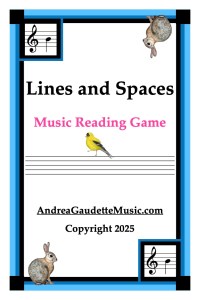
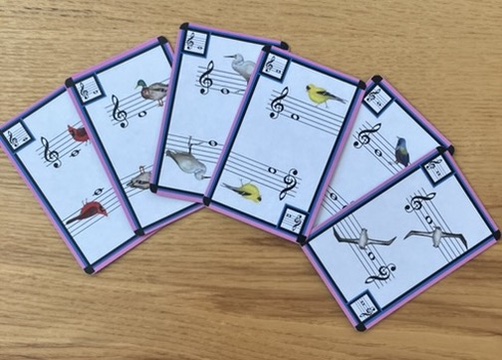
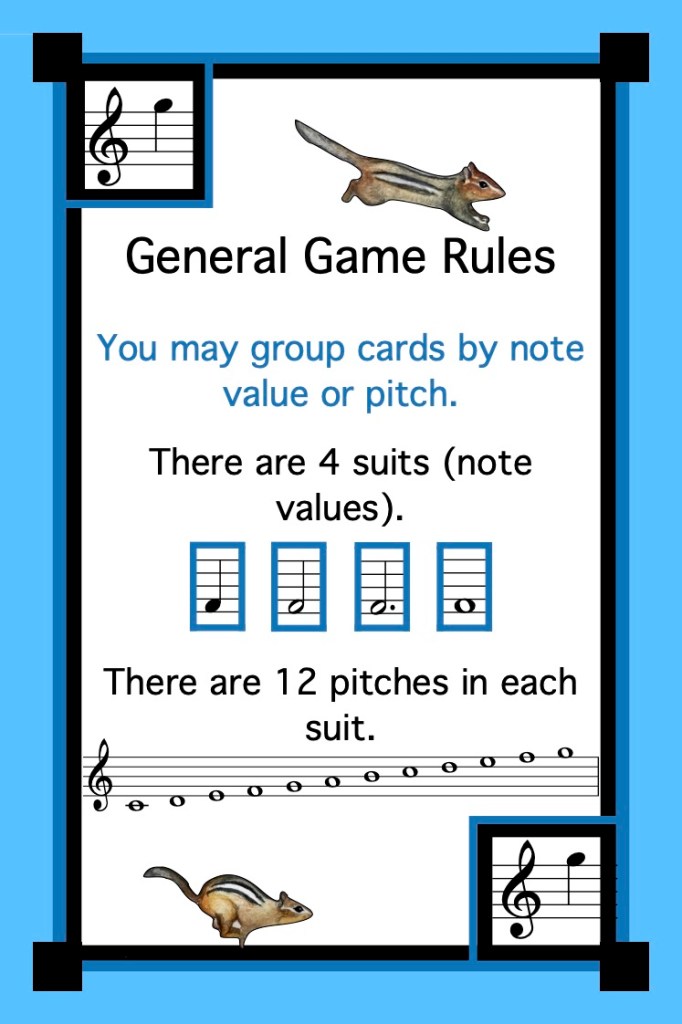
Lines and Spaces is a musical card deck. It is designed to help students playfully understand the mathematical logic behind standard music notation. The illustrated deck holds 48+ cards. It includes the pitches C4-G5 on the treble staff. These appear in whole, half, dotted half, and quarter note “suits”. Any traditional card game can be played using this deck. 4 jokers are included to accommodate a 52-card deck.
Suggestions for Lines and Spaces Activities
Using a 48-Card Deck
Music is a whole-brain engagement, and one of the parts of the brain that music tickles is mathematical thinking. When introducing the Lines and Spaces deck, I like to ask my students a question. How many different ways can we divide 48 cards? If the cards can’t be divided equally in a group, I ask the students a different question. How many cards need to be removed for it to be fair? (This is very important. No one wants to start a game at a disadvantage!)
I can also use the deck of cards to divide my students into groups. Suppose there are 24 students in my class. I would like to divide them into 4 equal groups. I will create a deck that includes the pitches C, D, E, F, G, and A. These are in all 4 rhythmic value suits (whole, dotted-half, half and quarter notes). Then I will ask students to walk through the room to gather with those who have the same rhythmic value. (To keep this activity short, the first team to find all 6 players wins a small recognition.) This is a fun way to practice identifying and labeling different rhythmic values.
Card Activities as Activators
This deck is best used in card games that reinforce specific sight reading skills.
While Lines and Spaces provides engaging opportunities to practice visual decoding, it does not connect sound to sight. Teachers should tackle that missing connection within each lesson. They should also explain the theory behind the symbols at their discretion.
Assessment
- Students can log the cards they play using correct notation. They should label each note with its letter name.
- Informal observation will reveal whether a student can recognize a card by its letter name and/or rhythmic value.
Lines and Spaces is inspired by the various card games I played on snow days. I enjoyed them with my siblings when I was growing up in New England. I designed them for my K-8 music students. Now, I love playing Rummy 500 on Lines and Spaces. I enjoy playing this game especially with my brother! For adults, it’s very fun to play the more complex games. The extra challenge of substituting notation for numbers really makes you think!
How to Play
Crazy G’s
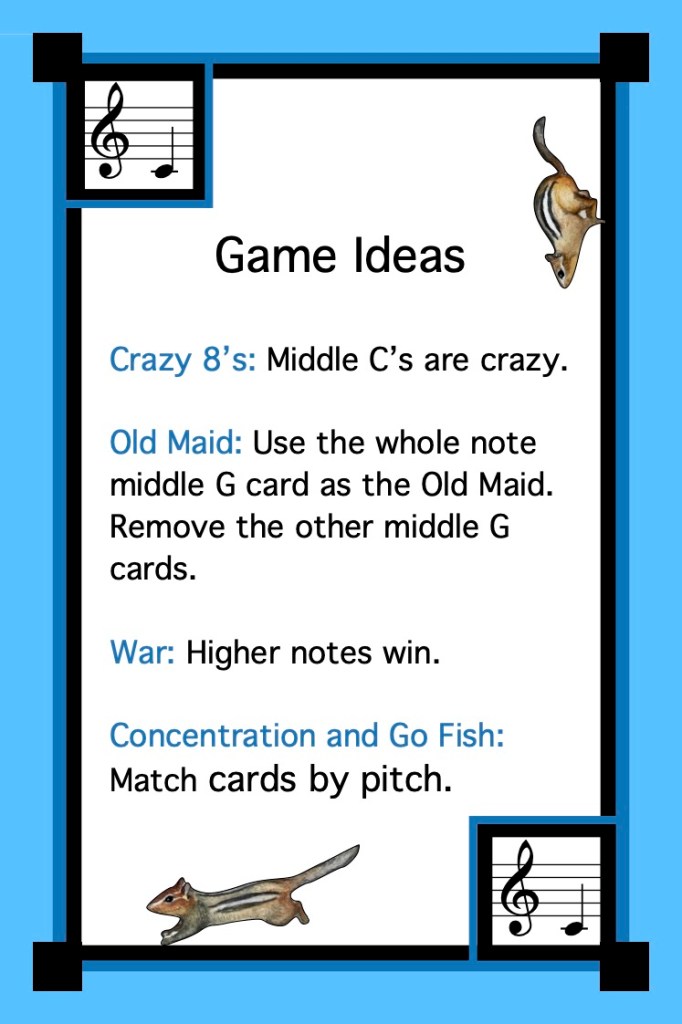
Here is an example of the traditional card game, Crazy 8’s, reimagined in the Lines and Spaces card deck.
Object of the Game: The winner is the first player to get rid of all the cards in their hand. (For children: the player with the most cards when the stockpile runs out is the winner.)
Deal: Start with the player to the dealer’s left. Move in a clockwise motion. Deal 5 cards, face down, one at a time, to each player. Place the rest of the deck face down to form a stock pile. Turn the first card of the stockpile face up to form a discard pile.
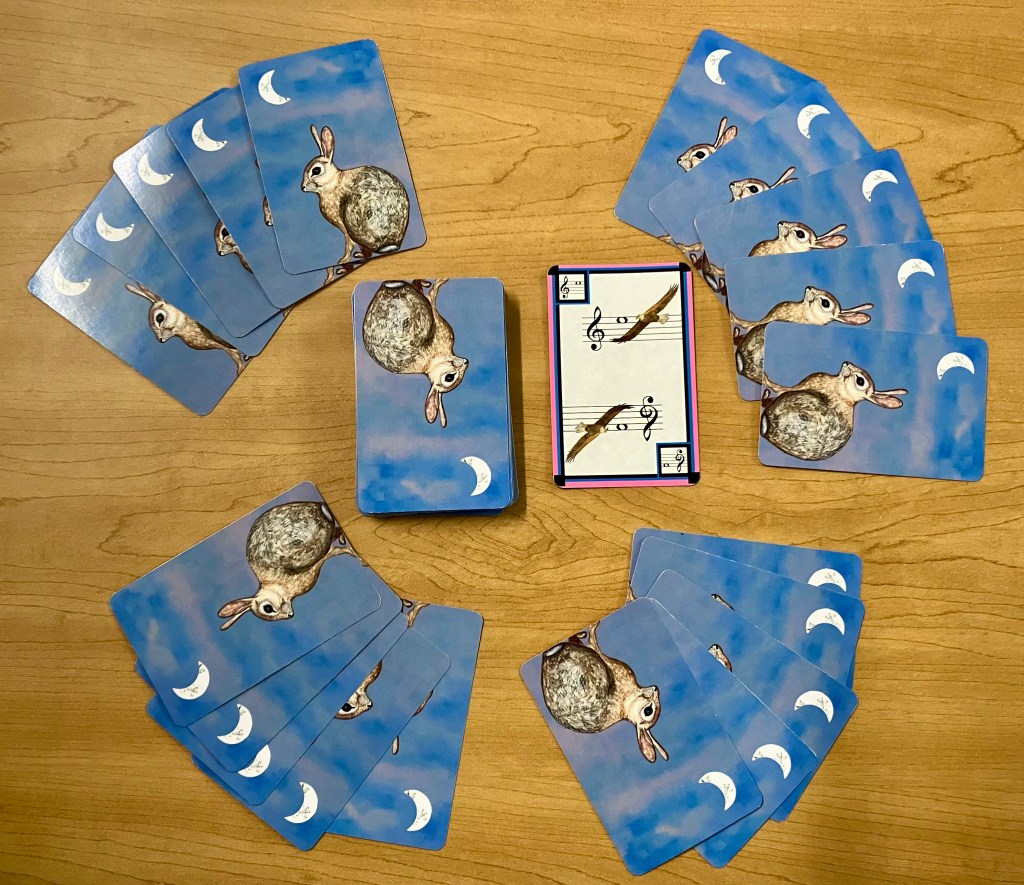
To Play: The player to the dealer’s left starts the game. Each player must place a card on the discard pile. They do this one at a time, in a clockwise motion. The card must match either the suit or pitch of the top card in that pile.

Example: If there is a whole note high E on top of the discard pile, the next player has two options. They can put either another whole note or another high E on top of that card. In the above image, a whole note F has been chosen to follow the first card.
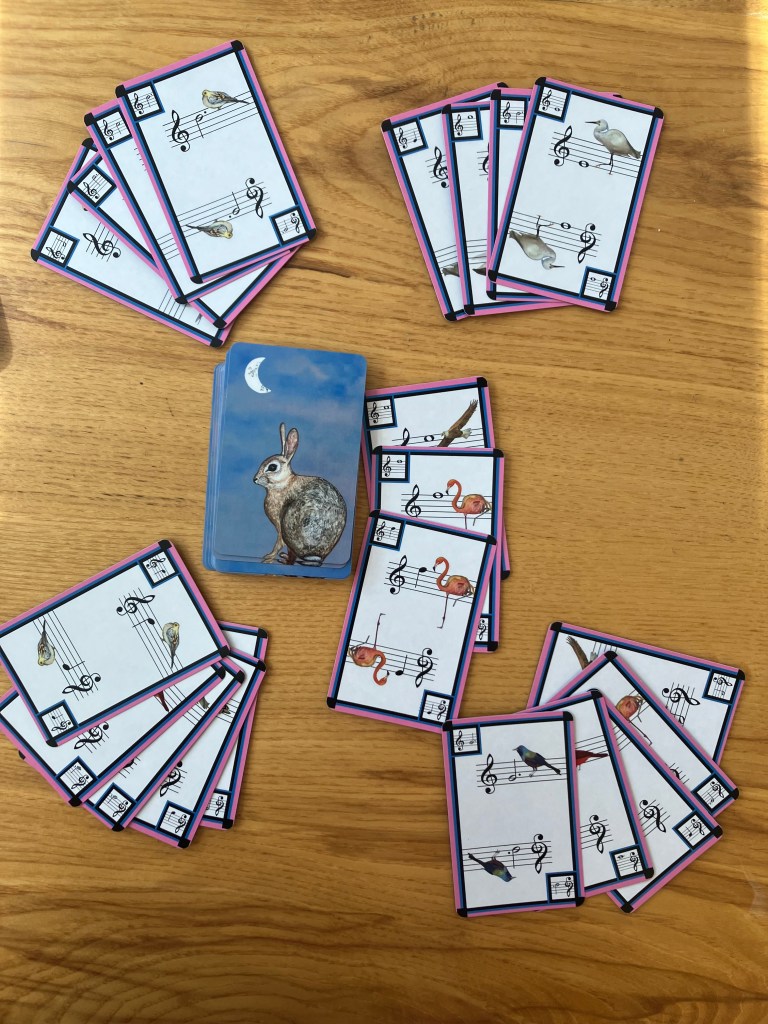
The next player has chosen to change suits to quarter notes by playing a quarter note high F.
There is one exception to this rule: treble clef G’s are wild! Any treble clef G (G4) can be played during any turn to change to any suit of the player’s choice. The next player must play a card in the newly chosen suit.
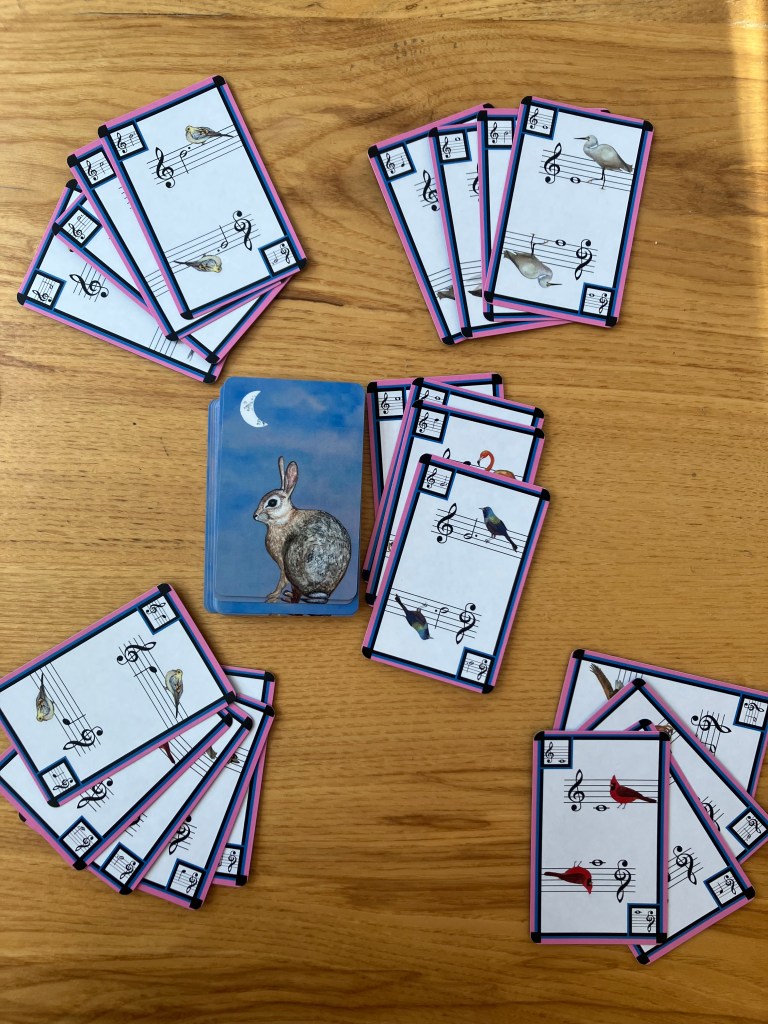
If a player can’t play, they must draw cards from the stock pile. They do this one at a time. They continue until they get an appropriate card to play.
When the stockpile is finished, keep the top card from the discard pile. Shuffle the other cards and lay them face down to form a new stock pile. Continue to play until one player wins all of the cards.
For children, here is a shorter way to play: Continue to play until the stock pile is empty. Then count the remaining cards in each player’s possession. The player with the most cards wins.
 Andrea Gaudette Music